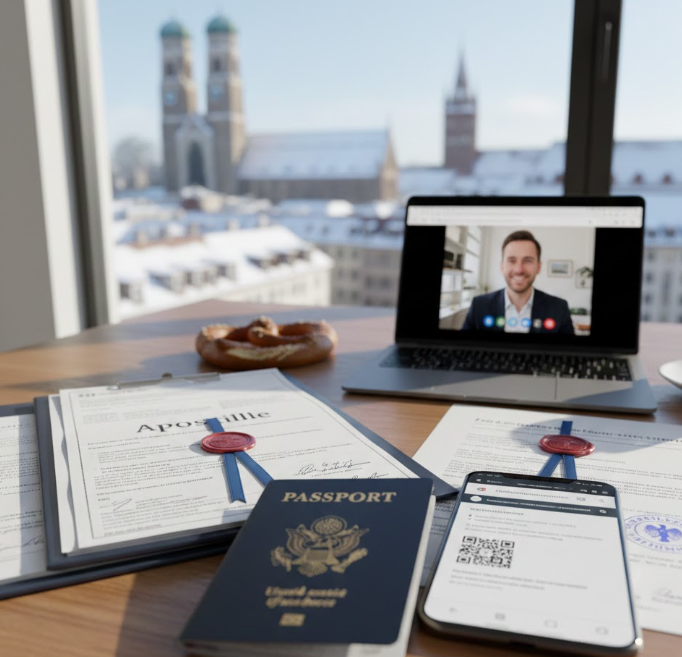
Whether you are applying for a Freelancer Visa, a Blue Card, or buying that dream apartment in Berlin, German bureaucracy (and German banks) will eventually ask for your Finanzierungsnachweis—proof of financial resources.
In 2026, German authorities have significantly tightened their standards. A basic bank statement is no longer enough to prove you can support yourself. To be legally recognized in Germany, your U.S. bank statements must be “internationalized” via an Apostille.
Why the Ausländerbehörde Demands an Apostille
Under the Hague Convention, an Apostille acts as a universal “seal of truth.” When you present a U.S. bank statement to a German official, they have no way of knowing if that signature from a bank manager in Ohio is real. The Apostille:
- Verifies the Authority: Confirms the bank official had the power to sign the document.
- Authenticates the Notary: Proves the U.S. notary who witnessed the signature is licensed and active.
- Prevents Rejection: Without it, many Beamte (officials) will reject your proof of funds, leading to visa delays or even “fictional certificates” (Fiktionsbescheinigung) being denied.
When Do Americans in Germany Need This?
You will likely need an apostilled financial statement for:
- Visa & Residency Permits: Proving you meet the 2026 minimum income requirements for the Freelancer or Job Seeker visa.
- Renting or Buying Property: German landlords and mortgage lenders (like Sparkasse or Deutsche Bank) often require verified proof of U.S. assets.
- Opening Business Accounts: If you are starting a GmbH or UG, your initial capital contribution must be proven via authenticated documents.
- Marriage and Family Reunion: Demonstrating that the “household income” is sufficient to support a spouse or children.
The Process: From Wall Street to Berlin
Getting your statements ready involves a specific chain of events that must be followed perfectly to be accepted in Germany:
- Step 1: The “Live” Signature. You cannot use a standard monthly PDF. You must request a letter from your bank (on letterhead) signed by a bank official.
- Step 2: The Notarization. That bank official’s signature must be notarized by a U.S. Notary Public. Crucial: The notary must be from the same state where the bank official is located.
- Step 3: The State Apostille. The notarized document is sent to the Secretary of State. They attach the Apostille, certifying the notary’s credentials.
- Step 4: German Translation. Most German offices require a certified translation by a beeideter Übersetzer (sworn translator) in Germany.
Common 2026 “Finanz” Pitfalls
- The “Old Data” Trap: German offices usually demand that statements be no more than 30 to 90 days old. If your Apostille process takes too long, your document might be expired before your appointment.
- Electronic Signature Rejection: Many German Finanzämter still reject “DocuSign” or digital signatures. Always insist on a “wet ink” signature from your bank.
- Wrong Jurisdiction: An Apostille from New York won’t work for a notary in California. The state of the notary and the state of the Apostille must match.
How We Simplify Your German Transition
Navigating U.S. state laws while sitting in a cafe in Munich is nearly impossible. FBI Background in Germany specializes in bridging this gap.
We handle the heavy lifting:
- Expert Review: We ensure your bank’s notarization is “Apostille-ready” before you spend money on shipping.
- Nationwide Coverage: We coordinate with Secretaries of State across all 50 states.
- Expedited Handling: We understand that your Ausländerbehörde appointment is a “one-shot” opportunity. We get your authenticated documents to you fast.
Don’t let a missing seal stand between you and your life in Germany.
Secure Your Financial Apostille Now