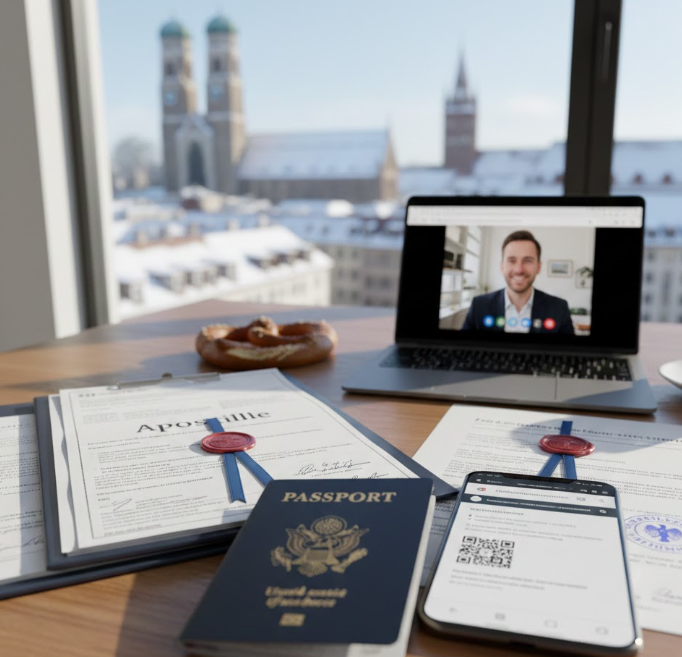
If you’ve spent more than five minutes researching your move to Germany, you’ve likely hit a wall labeled “Apostille.” While it sounds like a complex legal term, it is actually a tool designed to make your life easier—provided you know how to use it.
Essentially, an Apostille is a simplified international verification for countries that belong to the 1961 Hague Convention. Since both the U.S. and Germany are members, they have agreed to recognize each other’s documents, but only if they carry this specific “golden seal.”
The “Passport” for Your Paperwork
Think of an Apostille as a passport for your birth certificate, FBI background check, or diploma.
When you hand a U.S. document to a German official at the Ausländerbehörde (Immigration Office) or the Standesamt (Registry Office), they don’t have the tools to verify if a signature from a notary in Florida or an FBI agent in West Virginia is real. The Apostille acts as a bridge. It confirms three things:
- The Origin: Where the document came from.
- The Authority: That the person who signed it actually had the legal power to do so.
- The Seal: That the stamps on the document are genuine.
Why is this necessary for your life in Germany?
Imagine trying to prove you are legally single so you can marry your German partner in Munich, or trying to prove you have a Master’s degree to qualify for a Blue Card. Without an Apostille, German authorities are legally allowed to—and often will—reject your U.S. documents as “unverifiable.”
The Apostille process bypasses the old, nightmare-inducing “embassy legalization” that required months of mailing papers back and forth between different consulates.
4 Pillars of the Apostille Process in 2026
1. The Hague Connection Apostilles only work between member countries. Because Germany and the U.S. are “Hague-compliant,” you don’t need to visit a German Consulate to verify your papers. The Apostille from the U.S. is sufficient.
2. It Certifies the Official, Not the Facts Crucial distinction: An Apostille doesn’t prove that your bank balance is high or that your degree is valid. It simply proves that the government official who signed the document is who they say they are. In the eyes of German law, if the official is verified, the document is “legal.”
3. State vs. Federal Jurisdictions This is where Americans often get stuck.
- State Documents: (Birth/Marriage certificates, Notarized statements) are apostilled by the Secretary of State where the document was issued.
- Federal Documents: (FBI Background Checks) must be apostilled by the U.S. Department of State in Washington, D.C.
4. Physicality is King In 2026, while the world goes digital, German bureaucracy still loves “wet ink” and original stamps. Most German offices will not accept a scan or a printout of an Apostille. You need the original physical certificate attached to your original document.
Simplifying Your German Transition
At FBI Background in Germany, we take the mystery out of the “Apostille” stamp. Whether you are dealing with a birth certificate from California or an FBI check from D.C., we ensure your documents are prepared to meet the strict standards of German administrative law.
An Apostille is your document’s ticket to a new life. Let us help you get it stamped.
Confused about which authority needs to sign your document? Contact Us Today for a free document review.